Trusted Sites to Buy Peptides: How to Tell a Reliable Supplier in 2026
You are one bad batch away from a ruined experiment. A vial with no traceable certificate of analysis tells you nothing about purity, sterility, or what else is in the powder. In 2026, verifying a supplier takes minutes if you know which documents to demand.
This article shows what separates a reliable peptide source from a storefront with a polished homepage. You will learn the red flags Kovagen avoids, how independent batch testing and public COAs work, what shipping to the US and Canada involves, and who should not buy research peptides at all.
What Is Kovagen (KOVA)? Who It Serves and What It Supplies
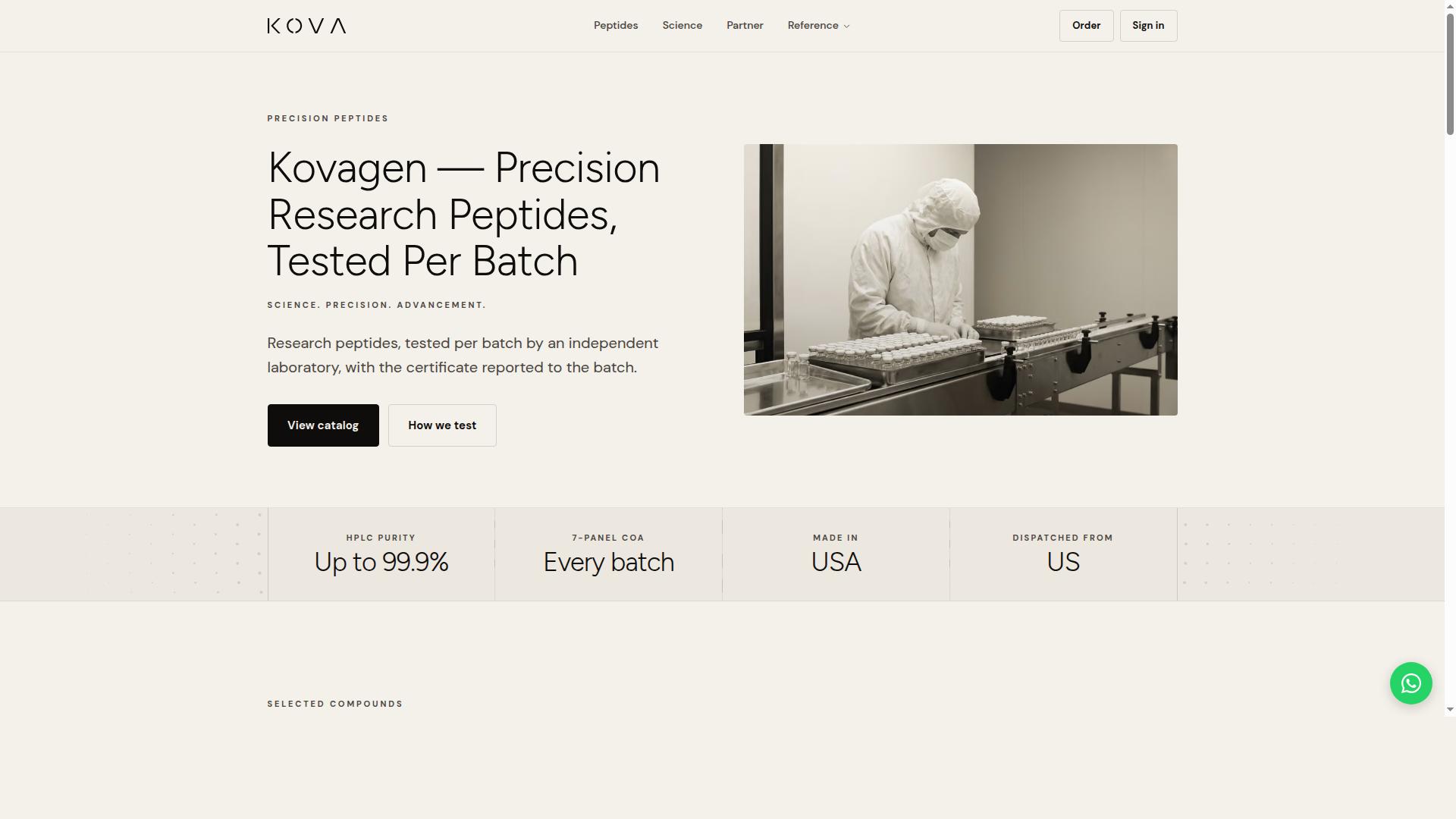
Kovagen (KOVA) is a research peptide supplier that sells lyophilized powders and research supplies exclusively for laboratory use. The brand operates under the short description "Precision Research Peptides, Tested Per Batch." That tagline captures its core promise: evidence is the product, and testing happens at the batch level rather than once in a while.
The operating company behind the store is Hybrid Tech Rainbows LLC, headquartered at 30 N Gould St, STE R, Sheridan, WY 82801, United States. Buyers evaluating trusted peptide suppliers in the 2026 peptide market can verify a real, named business entity and a physical address. That matters for reliable vendor verification.
Kovagen positions itself around the principle "Science. Precision. Advancement." Its catalog is not aimed at casual buyers. Every material is supplied for laboratory research use only and is not for human or veterinary consumption.
The target audience is narrow and clearly stated: laboratory researchers only. That focus shapes how the company presents its products, its documentation, and its quality claims. For anyone comparing peptide suppliers, this clarity is a useful signal of supplier reputation.
Kovagen Peptides stocks 30 compounds, made up of 22 single peptides and blends. All are supplied as lyophilized powder, alongside research supplies. Lyophilized format supports stability during storage and transport, which is a practical concern for lab workflows.
Pricing examples from the catalog give a sense of range and accessibility:
- Retatrutide (GLP-3) from $95.00
- BPC-157 10mg at $80.00
- GHK-Cu from $55.00
These figures show a spread from entry-level compounds to higher-priced research items. Researchers can match budget to study needs without guessing at hidden costs.
The quality story rests on independent analytical laboratory testing for every batch. Certificates of analysis are tied to each batch, so documentation follows the specific vial a researcher receives. This is the kind of COA authenticity that separates reliable suppliers from scam peptide websites.
For lab buyers, batch-linked certificates support traceability and help confirm HPLC purity results where provided. Kovagen ships to the United States and Canada, serving researchers across both markets.
In short, KOVA is a clearly defined research peptide supplier with a named operator, a stated address, a focused catalog, and a batch-testing commitment. For researchers weighing supplier options in 2026, that combination is a credible foundation.
Is Kovagen a Trusted Site to Buy Peptides in 2026?
Trust in the 2026 peptide market hinges on verifiable third-party testing, transparent batch records, and clear regulatory compliance, three areas where KOVA makes specific, checkable claims. A researcher evaluating any trusted peptide supplier should start with COA authenticity, then review HPLC purity results, and finally assess supplier reputation.
Kovagen publishes per-batch certificates from an independent analytical laboratory and allows batch-number lookup without an account. That structure stands in sharp contrast to scam peptide websites that post a single generic COA or none at all.
KOVA ships only to the United States and Canada, which aligns with import regulations and reduces customs seizure risk. The comparison below shows how these practices measure up against common red flags.
The Red Flags Kovagen Avoids - and How It Measures Up
Kovagen avoids several red flags that commonly appear on scam peptide sites: missing or generic COAs, no batch-level traceability, and unclear laboratory testing arrangements. Each point below pairs a known warning sign with the practice KOVA follows instead.
- COA authenticity: certificates are published per batch and retrievable by batch number without an account, rather than a single generic PDF reused across products.
- Testing independence: every batch is tested by an independent analytical laboratory, not in-house.
- Purity documentation: HPLC purity up to 99.9% is reported per batch, giving researchers a concrete figure to check against peptide purity standards.
- Contamination risks: the 7-panel COA covers contamination screening.
- Regulatory transparency: KOVA supplies products for laboratory research use only and makes no human-use claims, avoiding the kind of marketing that draws FDA warning letters.
- Shipping scope: shipments go only to the U.S. and Canada, lowering customs seizure risk compared with suppliers that ship worldwide without regard to import regulations.
Two gaps deserve honest mention. Kovagen states it does not publish customer reviews, so Trustpilot ratings and similar reputation signals are not part of its verification path. It also does not provide dosing, administration, or reconstitution guidance.
Neither omission undermines the core case. For a research-use supplier, batch-linked third-party data carries more weight than testimonials, and the absence of use guidance keeps the offering squarely within research chemical legality. A buyer who wants proof over promises can check the certificate for a specific vial and reach a clear conclusion.
Verdict: Kovagen is a trusted site to buy peptides in 2026. Per-batch independent testing, batch-number COA lookup, a 7-panel certificate, and a defined shipping scope give researchers verifiable answers where scam peptide websites offer none.
Key Features and What Makes Kovagen Stand Out
Kovagen's differentiators center on batch-level analytical transparency and account-free access to testing records, rather than broad catalog claims. In a 2026 peptide market crowded with vague quality statements, that focus gives researchers something concrete to check.
Two features carry most of the weight. First, independent batch testing with public certificates of analysis, where every batch is analyzed by an outside laboratory and the certificate is published. Second, a 7-panel COA that includes HPLC purity, plus a batch-number lookup that works without an account.
Certificates are tied to each batch and retrievable by batch number, so a document can be matched to the vial in hand. The sections below explain the testing workflow and the panel details.
Independent Batch Testing and Public Certificates of Analysis
Every Kovagen batch is sent to an independent analytical laboratory, and the resulting certificate of analysis is published and tied to that specific batch number. The distinction matters: a lab outside the supplier's own operation has no incentive to protect the supplier's numbers.
The workflow is straightforward and repeatable:
- A batch is produced and assigned a batch number.
- Samples are drawn from that batch and submitted to the independent lab.
- The lab runs its methods and issues a certificate of analysis.
- Kovagen publishes the certificate and links it to the batch number.
Because the certificate is retrievable by batch number without creating an account, reliable vendor verification becomes a task anyone can complete before or after purchase. No login, no sales conversation, no waiting on support.
A usable COA should contain the lot or batch number, the test methods applied (such as HPLC), the purity result, and the full panel results. If any of those elements are missing, the document tells you less than it appears to.
This per-batch approach also supports COA authenticity checks. Sites that post a single generic certificate for an entire catalog give you no way to connect a document to a specific vial. Batch-specific certificates close that gap and separate Kovagen from suppliers who treat testing as a marketing asset rather than a record.
HPLC Purity, 7-Panel COA, and Batch-Number Lookup Without an Account
Kovagen reports HPLC purity up to 99.9% and provides a 7-panel COA that covers identity, purity, and contamination screening. Each panel answers a different question about the material in the vial.
- HPLC purity: separates components and shows how much of the sample is the target peptide versus related impurities.
- Mass spectrometry verification: confirms molecular identity, so the substance matches what the label claims.
- Endotoxin testing: screens for bacterial endotoxins, a contamination risk relevant to any injectable-adjacent research material.
- Sterility testing: checks for microbial presence.
- Heavy metal screening: detects metal contaminants that synthesis and handling can introduce.
- Residual solvents: identifies leftover solvents from the manufacturing process.
- Moisture and content: measures water content and actual material present where applicable.
Together these panels speak to peptide purity standards more fully than a purity figure alone. A high HPLC number paired with a failed identity or contamination panel would be a warning, not a green light.
Reading an HPLC result is simpler than it looks. The certificate typically shows a main peak at a specified retention time with the purity percentage calculated from peak area. A single dominant peak with minimal shoulder peaks indicates a cleaner sample.
The lookup itself takes little effort. Navigate to the COA page, enter the batch number printed on the vial, and the certificate appears without an account. Because results are batch-specific, always match the COA to the batch number on your vial rather than assuming one certificate covers a whole product line. That habit is the core of supplier reputation checking in the 2026 peptide market.
Pricing and Ordering: What You Pay and How It Ships
Kovagen prices are listed in USD, with examples ranging from $55.00 for GHK-Cu to $140.00 for the Wolverine blend (BPC-157 / TB-500) 10/10. The table below shows a sample of the catalog so you can compare at a glance.
| Product | Price (USD) |
|---|---|
| GHK-Cu | from $55.00 |
| BPC-157 10mg | $80.00 |
| TB-500 Thymosin Beta-4 (Long Chain) 10mg | $85.00 |
| Retatrutide (GLP-3) | from $95.00 |
| Wolverine (BPC-157 / TB-500) 10/10 | $140.00 |
All ordering runs through the official website, Kovagen.com. The partner program pays 25% on each referred new customer's first eligible order, then 10% on eligible repeat orders for life.
Shipping to the United States and Canada
Kovagen ships to the United States and Canada only, using FedEx 2Day for every U.S. order with dispatch by the next business day. That clear service area is itself a useful signal for anyone comparing trusted peptide suppliers in the 2026 peptide market.
A supplier that states its shipping scope plainly is easier to vet than one making vague international claims. Kovagen cannot ship anywhere else at this time, so researchers outside the United States and Canada should not attempt to order.
This matters for import regulations and customs seizure risk. A parcel sent outside a supplier's declared service area is more likely to be stopped, held, or destroyed in transit, and the buyer carries that loss. Knowing the boundary in advance protects your budget and your research timeline.
Shipping scope also belongs on any reliable vendor verification checklist. Cross-check the stated service area against the checkout page and the carrier named in the order confirmation. When all three agree, the supplier is communicating honestly about logistics, which is a positive sign for the rest of the operation.
For U.S. buyers, the FedEx 2Day method and next-business-day dispatch give a predictable window for planning lab schedules. Researchers in Canada can order with the same confidence in the declared service area, while everyone else should treat the restricted scope as a hard stop rather than a detail to work around.
Trust Signals: Contact, Transparency, and Track Record
Kovagen's trust signals include a published postal address, a direct email with a one-business-day response commitment, a WhatsApp contact, and batch-level COA transparency. Together these give researchers several concrete ways to confirm who they are dealing with before placing an order.
In the 2026 peptide market, scam peptide websites often hide behind a contact form and nothing else. A supplier that publishes verifiable corporate details is easier to hold accountable, and that matters when counterfeit peptides and underdosed vials are a known risk.
The operating company behind the store is Hybrid Tech Rainbows LLC, listed at 30 N Gould St, STE R, Sheridan, WY 82801, United States. A named legal entity tied to a physical postal address is one of the simplest supplier reputation checks available.
Researchers can cross-reference that address and company name independently. If a vendor cannot be matched to a registered business location, that is a warning sign worth taking seriously.
Kovagen lists three direct contact channels, each suited to a different need:
- Email: contact@kovagen.com, with a stated response time of within one business day
- WhatsApp: +1 619 335 7514 for quicker back-and-forth questions
- Official website: Kovagen.com, which serves as the primary source of product and policy information
A published response commitment is itself a transparency signal. It gives buyers a benchmark for judging how quickly a supplier answers pre-sale questions about COA authenticity or HPLC purity results.
Notably, no other social, directory, or review profiles are listed in the scraped content. That means researchers should rely on the official site and direct contact rather than third-party review aggregators such as Trustpilot for this vendor.
This is not unusual for specialist research chemical suppliers, and it cuts both ways. Customer reviews on aggregators can be gamed in either direction, so a direct email exchange often reveals more about a supplier than a star rating does.
When you contact a vendor directly, ask specific questions about third-party lab testing, peptide purity standards, and batch documentation. The quality and speed of the reply tells you a great deal about how the operation is run.
Batch-number COA lookup without an account is another meaningful trust signal. Requiring no login to view a certificate of analysis suggests the documentation is meant to be checked, not gated.
For researchers focused on contamination risks and batch documentation, easy access to batch records supports reliable vendor verification. It also makes it harder for a supplier to substitute documents after the fact.
Weigh these signals together rather than in isolation. A published company name and address, direct email and WhatsApp contact, a stated response window, and open batch-level COA access form a coherent picture of an accountable supplier.
For Kovagen specifically, the evidence points to a legitimate operation: a named LLC, a verifiable US address, responsive direct channels, and documentation that does not hide behind an account wall. Researchers comparing trusted peptide suppliers in 2026 can use these same checks on any vendor they consider.
Who Should Use Kovagen - and Who Should Not
Kovagen is intended for laboratory researchers who need documented, batch-traceable research peptides, and it is explicitly not for human or veterinary consumption. That single boundary shapes everything about who the store suits. If your work happens in a lab, follows a research protocol, and depends on paperwork you can check yourself, Kovagen is built around your needs. If your intended use falls outside that frame, the store is the wrong fit, and it says so plainly.
The right audience is laboratory researchers purchasing lyophilized peptides and research supplies for in-vitro or research use. These buyers typically care less about marketing language and more about whether a batch can be traced and verified. Kovagen's model speaks directly to that priority.
Two features matter most for this group. First, independent batch testing gives researchers documentation they can evaluate on its own merits. Second, account-free COA retrieval means a buyer does not need to create a login or request paperwork by email to see the certificate of analysis for a specific batch.
That second point deserves emphasis. In the 2026 peptide market, COA authenticity is one of the clearest signals of a reliable supplier. A store that lets anyone pull batch-specific documentation without friction is making verification easier, not harder. For researchers who treat reliable vendor verification as part of their purchasing routine, that matters.
Kovagen also fits researchers who understand that documentation is a starting point, not a finish line. A certificate of analysis should be read alongside HPLC purity results, not instead of them. Buyers who already think this way will find the store's approach familiar.
Finally, the store suits researchers who value a clear scope. All materials are supplied for laboratory research use only. Buyers who want a supplier that states that boundary up front, rather than burying it, are the intended audience.
Just as important is who should look elsewhere. The following groups fall outside Kovagen's scope, and the reasons are practical rather than judgmental.
- Anyone seeking products for human or veterinary consumption. Kovagen supplies materials for laboratory research use only. This is a firm boundary, not a suggestion.
- Researchers outside the United States and Canada. Kovagen does not ship beyond these two countries, so international buyers face customs seizure risk and import problems that the store does not serve.
- Buyers who require GMP compliance or ISO certification documentation. Kovagen does not claim either, so anyone whose procurement rules demand those credentials should source elsewhere.
- Anyone unwilling to verify batch-specific COAs. If checking documentation per batch feels like too much effort, the store's account-free COA model offers little value.
That last group is worth pausing on. A supplier can only support reliable vendor verification if the buyer actually performs it. Researchers who skip the COA check lose the main protection against underdosed vials, contamination risks, and counterfeit peptides.
The geographic limit is equally concrete. With no shipping outside the United States and Canada, buyers in other regions cannot complete a legitimate order, and attempting to route around that introduces import regulations problems no researcher needs.
On certification, the distinction is honesty rather than shortcoming. Kovagen does not claim GMP compliance or ISO certification, so institutions that mandate those documents should treat the store as out of scope. Buyers who need that paperwork have a clear answer.
The verdict is straightforward. Kovagen is a legitimate fit for laboratory researchers in the United States and Canada who buy lyophilized peptides for research use, want independent batch testing, and will check batch-specific COAs themselves. It is not a fit for anyone buying for human or veterinary use, shopping from outside those two countries, requiring GMP or ISO documentation, or unwilling to verify certificates. Read those lines honestly, and the decision makes itself.
Final Verdict: A Reliable Peptide Supplier for 2026
For laboratory researchers in the United States and Canada, Kovagen (KOVA) presents a verifiable 2026 option: independent batch testing, public COAs retrievable by batch number, and clear contact details. The supplier meets the core vendor-verification criteria that matter most when judging trusted peptide suppliers, and it states its operating limits openly rather than overstating its credentials.
On the verification side, KOVA provides independent lab testing with per-batch certificates of analysis. Purity results from HPLC testing reach up to 99.9%, and the COA covers a seven-panel format that supports closer review of each batch.
Just as important, COA authenticity is easy to check. Batch documents can be looked up without creating an account, which removes a common barrier that scam peptide websites rely on. Researchers can confirm a document matches the vial in hand before use.
The limits are stated plainly. KOVA ships to the United States and Canada only, sells research-use-only materials, and makes no GMP or ISO certification claims. That honesty is itself a signal of supplier reputation, since inflated compliance language is a frequent red flag in the 2026 peptide market.
Verification does not end with the website. Buyers should still confirm batch numbers, review HPLC purity results where available, and keep documentation on file. KOVA's account-free lookup makes that final check straightforward.
For direct questions, the supplier lists the following contact details:
- Email: contact@kovagen.com (response within one business day)
- WhatsApp: +1 619 335 7514
- Website: https://Kovagen.com
- Postal address: Hybrid Tech Rainbows LLC, 30 N Gould St, STE R, Sheridan, WY 82801, United States
Weighed against the standards covered in this guide, KOVA stands as a reliable, verifiable peptide supplier for 2026. Independent testing, public per-batch COAs, and transparent limits give researchers a supplier they can check rather than simply trust.
Frequently Asked Questions
How can I verify that a peptide supplier's lab testing is genuine?
Look for certificates of analysis (COAs) produced by an independent analytical laboratory rather than in-house testing, and check that each COA is tied to a specific batch number you can look up yourself. Kovagen (KOVA) publishes a COA for every batch, retrievable by batch number without an account, with HPLC purity up to 99.9% and a 7-panel COA. If a supplier can't connect a COA to your exact batch, treat that as a red flag.
What should I check before trusting a peptide vendor's website?
Confirm the operating company, a physical address, direct contact details, and clear documentation practices before ordering. Kovagen is operated by Hybrid Tech Rainbows LLC at 30 N Gould St, STE R, Sheridan, WY 82801, United States, and can be reached at contact@kovagen.com (responses within one business day) or via WhatsApp at +1 619 335 7514. Vague or missing company details are a warning sign.
Does Kovagen test every batch, or only some products?
Every batch is tested by an independent analytical laboratory, not in-house, and certificates are published per batch. This batch-level approach means the COA you check should match the specific vial you receive, not just the product category. You can retrieve the relevant certificate by batch number without creating an account.
Where does Kovagen ship, and how fast?
Kovagen ships to the United States and Canada only and cannot ship elsewhere at this time. Every U.S. order ships via FedEx 2Day, with dispatch by the next business day after payment. If a supplier's shipping claims seem inconsistent or unclear, ask for specifics before ordering.
Are Kovagen peptides intended for human use?
No. All Kovagen materials are supplied for laboratory research use only and are not for human or veterinary consumption. The catalog focuses on research peptides as lyophilized powder, including single compounds and blends, alongside research supplies. A reliable supplier should state this distinction clearly rather than implying consumer use.
How do I know a supplier's pricing is transparent?
Reputable suppliers list clear per-product prices in a stated currency rather than hiding costs behind quote forms. Kovagen lists prices in USD, for example BPC-157 10mg at $80.00, GHK-Cu from $55.00, and TB-500 Thymosin Beta-4 (Long Chain) 10mg at $85.00. Compare listed prices against the documentation provided, and be cautious of vendors who won't publish either.